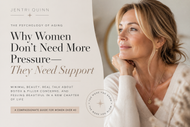
The Psychology of Aging: Why Women Don’t Need More Pressure — They Need Support
Posted by JQ on May 10th 2026
Ciao, Beautiful!
There comes a point in a woman’s life when she doesn’t just look in the mirror and wonder what changed on her face. She wonders what changed inside of her.
Maybe you’re in your 40s, 50s, 60s, or beyond, and you feel like you’re standing at the edge of a new chapter. Your skin is changing. Your body's changing. Your energy's changing. Maybe your confidence, your relationships, your hormones, your career, your family role, or even your sense of identity feels like it’s shifting all at once.
And then, on top of all of that, you open your phone and the world tells you that you need more. More products. More procedures. More steps. More fixing. More chasing. More youth.
At some point, you start to wonder, “Do I actually need all of this? Or am I being taught to feel like I’m not enough?”
That’s the part of beauty we don’t talk about enough: the psychology of aging.
After more than 25 years in beauty, and now as a licensed esthetician and oncology-certified esthetician, I can say this with my whole heart: beauty is not just about what you put on your face. It’s also about what you’re absorbing emotionally, mentally, and spiritually.
The woman who feels overwhelmed by aging usually doesn’t need to be shamed into buying more. She needs to feel supported. She needs to feel seen. She needs someone to remind her, “You’re not falling apart. You’re evolving.”
I was raised around beauty. My mom was a cosmetologist, and I grew up with beauty as part of everyday life. But she wasn’t the kind of woman who believed you needed a million things to be beautiful. She was a minimalist at heart. She believed in looking good, taking care of yourself, and using what worked but not chasing every trend.
I watched my (later, single) mom work, create, care for people, and hold things together. She was practical, but she also had a spiritual side. She practiced astrology, and while she didn't believe astrology should ever make your decisions for you, she did think it could be a lens. A way to reflect. A way to ask better questions. Not, “What is my chart forcing me to do?” but, “What am I being invited to understand about myself?”
Beauty shouldn't make choices for you. It should guide you back to yourself.
And that’s where I think so many women get lost. We start aging, and instead of asking, “What do I need in this season?” we ask, “How do I get back to who I was?” But what if that’s the wrong question? What if this new chapter isn’t about going backward? What if it’s about becoming more aligned with who you really are now?
When you're out of alignment, whether it be emotionally, physically, mentally — it shows. And when you're constantly consuming content that makes you feel less-than, that shows too.
Energy is contagious. What you watch matters. Who you listen to matters. The people you spend time with matter. The conversations you replay in your head matter. Pay attention to how you feel after you consume certain things. Do you feel inspired, calmer, and more hopeful? Or do you feel behind, unattractive, irrelevant, scared, and like you suddenly need to buy ten things or book an appointment to fix yourself?
That’s information. Your nervous system is giving you feedback.
As women, especially as we age, I think we have to become more protective of our energy. Not in a fearful way, but in a wise way. Because there's a big difference between being inspired and being triggered. There's a difference between learning something useful and being manipulated into insecurity. There's a difference between wanting to look refreshed and feeling like your natural face is a problem.
And I want to be very clear: this is not about judging women for the choices they make. I'm not here to shame anyone for Botox, filler, surgery, makeup, skincare, or anything else a woman chooses for herself. I’ve worked in beauty for over 25 years. I understand why women want to look refreshed. I understand why women want to feel pretty. I understand why women want to soften the signs of stress, aging, illness, exhaustion, grief, or hormonal change.
Wanting to look better is not shallow. A lot of times, wanting to look better means wanting to feel better.
Women are often put in an impossible position. If you care about your appearance, you’re vain. If you stop caring, people ask what happened to you. If you age naturally, you’re told you look tired. If you get procedures, you’re judged for trying too hard. It’s exhausting.
So I want this conversation to live in the compassionate middle. A place where we can tell the truth about beauty pressure, tell the truth about risks, and still hold deep empathy for why women are seeking solutions in the first place.
One of the reasons I wanted to have this conversation is because I’ve spent ample time in supportive online groups for people who've experienced serious reactions from cosmetic procedures, including botulinum toxin injury and filler reactions. Botulinum toxin products do carry a boxed warning about the risk of the toxin effect spreading from the injection site, and filler reactions can also happen when the body does not respond well to a foreign substance. This is not medical advice, and if you are experiencing symptoms after any cosmetic procedure, please work with a qualified medical professional. But emotionally, as a beauty professional, as an esthetician, and as a woman, I can say this: I've seen how deeply lonely women can feel when something they did to feel better turns into something frightening.
And what has struck me most is that in some of these online spaces, women may be dealing with symptoms that are debilitating, scary, and in some cases potentially dangerous, and yet, many of those same women are still asking beauty questions. They’re still asking, “What can I do for my wrinkles?” “What can I use instead?”
That might be hard for some people to understand, but to me, it makes perfect sense. Because when your body feels unfamiliar, your face can become one of the places where you search for yourself. When you’ve been through something physically or emotionally traumatic, wanting to feel beautiful again is not vanity. It can be part of wanting to feel human again. It can be part of recovery. It can be part of dignity. It can be part of identity.
That is one of the reasons I care so much about beauty that doesn't pressure women, beauty that doesn't prey on panic, and beauty that does not make women feel like their only choices are extreme. There are women who are scared. There are women who regret procedures. There are women who still want to look lifted, fresh, elegant, healthy, and alive — but they no longer feel comfortable taking the same risks.
Those women deserve guidance. They deserve options. They deserve to be spoken to with respect. They deserve to be reminded that there are still gentle, creative, beautiful ways to care for yourself.
That's where minimal beauty becomes powerful. Minimal beauty is not about doing nothing. It’s about doing what matters. It’s about understanding your skin, your features, your season of life, and your actual needs. It’s not about having the most products. It’s about having the right relationship with beauty.
Maybe your skin needs more hydration now. Maybe your makeup needs to be applied differently. Maybe your eyes need softer definition. Maybe your face needs less powder, less heaviness, less trend-chasing. Maybe your skin needs barrier support instead of constant exfoliation. Maybe your under eyes need moisture, light reflection, and better placement instead of heavy concealer. Maybe your face needs massage, circulation, rest, nourishment, and gentleness — not another aggressive thing to recover from.
And that doesn't mean you need to panic. It means you need to adjust.
That’s all aging really asks of us. Not to disappear. Not to fight ourselves. Not to become someone else. Just to pay attention and adjust.
When a woman says, “I feel like I don’t recognize myself,” she’s not just talking about fine lines. She’s talking about identity. She’s talking about grief. She’s talking about change. She’s talking about the version of herself she thought she’d still be, and the version she’s becoming.
That deserves compassion.
As an esthetician, I can teach you ingredients. I can teach you makeup placement. I can teach you how to support your skin barrier, how to brighten the eyes, how to soften the look of tiredness, and how to work with mature skin instead of against it. But the deeper work is helping you understand that you are not broken because you are changing.
The beauty industry doesn't always tell women that. Sometimes the beauty industry benefits from women feeling confused, overwhelmed, and afraid of aging. Sometimes social media benefits from keeping women emotionally activated. Because if you feel bad enough, you will keep watching. If you feel scared enough, you will keep searching. If you feel behind enough, you will keep buying.
That's why I want you to pay attention to what you’re consuming. Not just food. Not just skincare ingredients. Content. Conversations. Energy. Influence.
Ask yourself: How do I feel after I watch this person? Do I feel educated or inadequate? Do I feel empowered or panicked? Do I feel more connected to myself or more desperate to change myself? Do I feel calm enough to make a wise decision, or do I feel like I need to fix something immediately?
That pause can protect you. That pause can save you money. That pause can save your confidence. And sometimes, that pause can protect your body.
Because beauty decisions made from panic are rarely the best decisions. Beauty decisions made from alignment are different.
When you are aligned, you can say, “I want to improve this, but I don’t hate myself.” You can say, “I want to look refreshed, but I don’t need to chase every trend.” You can say, “I want support, but I also want safety.” You can say, “I am allowed to care about how I look, but I do not have to hand my power over to an industry that profits from my insecurity.”
That's why I want you to be informed. I want you to be discerning. I want you to know that beauty can be gentle. It can be minimal. It can be elegant. It can be supportive. It can be spiritual without being preachy. It can be practical without being cold. It can be emotional without being manipulative. And it can evolve with you.
Maybe aging is not asking you to do more. Maybe it's asking you to become more conscious. More discerning. More aligned. More loving toward yourself. And yes, more skilled.
Because skill matters. Knowing where to place your makeup matters. Knowing how to support your skin barrier matters. Knowing when to use less matters. Knowing when your skin is irritated matters. Knowing when a trend is not for you matters. Knowing when your energy is being drained matters. Knowing when your body is saying “no” matters.
And knowing that you still get to feel beautiful, even after disappointment, even after change, even after fear, even after a hard season — that matters too.
We are whole people. We are not just faces. We are not just symptoms. We are not just before-and-after photos. We are women with stories, nervous systems, histories, hormones, relationships, fears, hopes, and dreams. And if beauty does not honor that, then it is not deep enough.
So if you’re feeling like you’re in a new chapter, and you’re not exactly sure who you’re becoming yet, I want you to know this: you are not behind. You are not invisible. You are not too late. You are allowed to change. You are allowed to soften. You are allowed to simplify. You are allowed to want to look beautiful without apologizing for aging.
You are allowed to care about your appearance and still be a deep, wise, spiritual, intelligent woman. Those things are not in conflict. They belong together.
Maybe the next chapter of beauty isn’t about doing more. Maybe it’s about coming back into alignment. Choosing what supports you. Letting go of what drains you. Watching what you consume. Protecting your energy. Trusting your intuition. Asking better questions. Learning how to work with your beauty instead of against it.
That is where glow comes from.
Not perfection. Not youth. Not trends.
Alignment.
And when you align, you shine.
Maybe aging is not asking you to become less beautiful. Maybe it’s asking you to become less distracted. Less influenced. Less afraid. Less willing to abandon yourself for someone else’s version of beauty.
And maybe, if you’ve been through something that made you feel disconnected from your body or your face, wanting to feel beautiful again is not vanity. Maybe it’s a homecoming. Maybe it’s your spirit saying, “I’m still here.”
This chapter may not be about getting back to who you were. It may be about finally becoming the woman you were always growing into.
Remember, the more you know, the more you glow.
With love,
Jentri
P.S. If your own beauty routine has started feeling like too much, start small. Our Matte Beige Brow Highlighter, also known as the Eye Lift Stick, is one of my favorite minimal beauty tools for helping the eye area look a little more lifted, awake, and polished without heavy makeup or complicated steps.